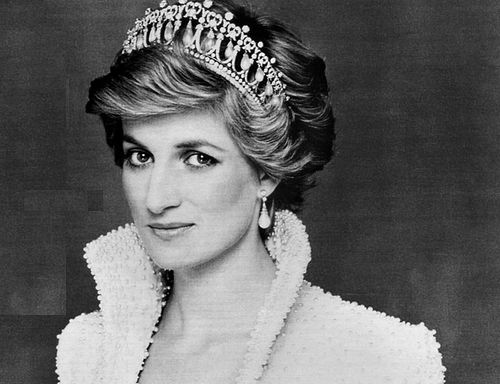
Showing posts with label Diana Princess of Wales. Show all posts

Thursday, September 6, 2012

6 September


A lot to do with ships today - then also some birthdays and a random few other historical events from all over the world

In 1522 One of the five ships that set out in Ferdinand Magellan's trip around the world made it back to Spain. Only 15 of the original 265 men that set out survived. Magellan himself had been killed by local inhabitants of the Philippines.

In 1907, the luxury liner Lusitania left London for New York on her maiden voyage.


The photograph left shows RMS Windsor Castle departing Cape Town for the last time on 6 September 1977. On the horizon left can be seen the SAN type 12 frigate SAS President Pretorius, waiting to intercept Windsor Castle. Out in the bay a shot was fired across the bow of Windsor Castle and she hove to, then a ‘boarding party’ from PP presented a commemorative plaque to the Captain of Windsor Castle and she was ‘allowed’ to continue her voyage. A fitting tribute to the end of an era.  (This information thanks to my friend Graham Sonnenberg's friend Tony Jones.  They count among those who dig up wonderful bits of information about Cape Town and its history.)


In 1901, the US President William McKinley was shot and  killed in Buffalo, New York by anarchist Leon Czolgosz. 

In 1966, there was another assassination: South Africa's  Prime Minister Hendrik Frensch Verwoerd, regarded  by many as the father of apartheid, was stabbed to death on 6 September in House of Assembly, in Cape Town, by a parliamentary messenger, Dimitrios Tsafendas.  Five years earlier, on 9 April 1961 there had been another attempt on his life when, at the Rand Easter Show, in Johannesburg, he had been shot twice in the face by David Beresford Pratt.

The date is also important in South African history for another reason: on this day in 1939, South Africa declared war on Germany under its new government led by Genl Jan Smuts (leader of the United Party). The previous day, Prime Minister JBM Hertzog resigned after his motion to remain neutral in the war was defeated by 80 votes to 67 (he reconciled with Daniel F Malan (Herenigde Nasionale Party) to become leader of the opposition.  

Two years later, in Germany on 6 September 1941, the head of the Secret Police in Germany ordered all Jews over 6 years old to wear a yellow star of David on their coats together with the word Jude (Jew).  Their movements without police permission were also curtailed.

Still in the 1940s, Queen Juliana of the Netherlands was inaugurated in Amsterdam on 6 September 1948.  Four years later (1952), across the channel, there was the Farnborough

Friday, August 31, 2012

31 August

On 31 August 1997, Diana, the Princess of Wales, Dodi Fayed and their driver Henri Paul were killed in a car crash in Paris.  Following an unprecedented outpouring of public mourning in Britain and beyond, her public funeral at Westminster Abbey on 6 September drew an estimated 3 million onlookers in London, as well as worldwide television coverage watched by as many as 2.5 billion people.

Four decades earlier, on this day in 1957 Malaya became an independent nation within the British Commonwealth.

Then, in 1978, four hundred of the world's top climatologists met in Geneva, Switzerland to discuss climate change and debate to what extent it is influenced by human pollution. The debate continues, while the planet continues to spin around its axis.  There is some action to address our role in climate change, but not enough.  whatever happens - unless there is some cataclysmic event that shatters the planet in the same way that our Moon was born in the early days of the formation of the Solar System - Earth will be here in a million, even a billion years.  But will mankind survive our own short-sightedness? Nobody knows.


Some first performances of famous music took place on 31 August:  Liszt's Graner Mass (1886), Rossini's opera William Tell, in Paris (1829) and  FP of Kurt Weill's Threepenny Opera, in Berlin (1928).

Birthdays today include the French poet Théophile Gautier (1811), the Italian composer Amilcare Ponchielli (1834) the singer/songwriter  Van Morrison (1945) and the violinist Itzhak Perlman (1945).


Christian's song

Today is also the birthday of my friend Christian Bresnier, who follows this blog regularly and who has been posting a "song of the day" regularly on Facebook.  I'm sharing his choice for the day, with his comments.   In fact, I think I am going to ask him if he will allow me to share his song choices regularly as a kind of "Christian's song choice".  

Here are his comments to today's song: "For my birthday song I chose this poem which I consider one of the most beautiful and poignant and which captures the essence of regret and nostalgia. Pity that the English subtitles are so pedestrian. There exists a great english version by Graeme Allwright but unfortunately unavailable on the Internet. Incidentally, George Brassens is my favorite French lyricist, a bon-vivant par excellence, warm, naughty and funny and his death in 1982 or thereabouts touched me deeply. I don't have 'idols' but there is a man I would have liked to meet."


Tuesday, August 28, 2012

28 August


Today's entries are mainly political and scientific. Way back, on 28 August 1619,  Ferdinand II was  elected emperor of the Imperium Romanum Sacrum, the Holy Roman Empire. 

More than two centuries later, the Slavery Abolition Act of  1833 enacted by the British Parliament outlawed slavery in the British Empire, thus liberating around 700 000 people. 

And talking about empires and spheres of influence, on 28 August 1867  the United States took possession of the tiny Midway Atoll (only slightly more than 6 km2 ) in the North Pacific Ocean.  A century later the Battle of Midway (1942)  became an important naval milestone of World War II when the US  Navy defeated a Japanese attack.

Another empire collapsed on 28 August 1991, when  Mikhail Gorbachev resigned as General Secretary of the Soviet Communist Party of the then Soviet Union.  On the same day, the Ukraine declared its independence from the USSR.
Here, courtesy of the British Library,
is the original score of Herschel's 
Symphony No 15   

On this date in 1789 William Herschel, the German-born British astronomer who was also a prolific composer, discovered one of my favourite moons in the Solar System - Saturn's beautiful Enceladus. Herchel is, of course, perhaps best known as the astronomer who discovered the planet Uranus in 1781. Currently we are learning more about Enceladus and other moons in the Saturn system via the Jet Propulsion Laboratory's Cassini mission.  

The first issue of Scientific American magazine was published on 28 August 1845.  It is now the oldest continuously published monthly magazine in the US with